
Access to timely finance can make a significant difference to both household finances and business growth. Whether an individual needs money to meet an unexpected expense or an entrepreneur wants to expand operations, borrowing can provide the funds required to move forward. However, choosing the right type of loan is just as important as securing approval.
Personal loans and business loans serve different purposes, even though both allow borrowers to access funds and repay them over an agreed period. Understanding their differences in terms of eligibility, interest rates, loan amounts, documentation and repayment obligations can help individuals and business owners make better financial decisions.
For small businesses, startups and micro, small and medium enterprises (MSMEs), selecting the appropriate financing option can be particularly important. The right loan can support growth and cash flow, while an unsuitable borrowing decision may put pressure on finances.
Understanding Personal Loans and Business Loans
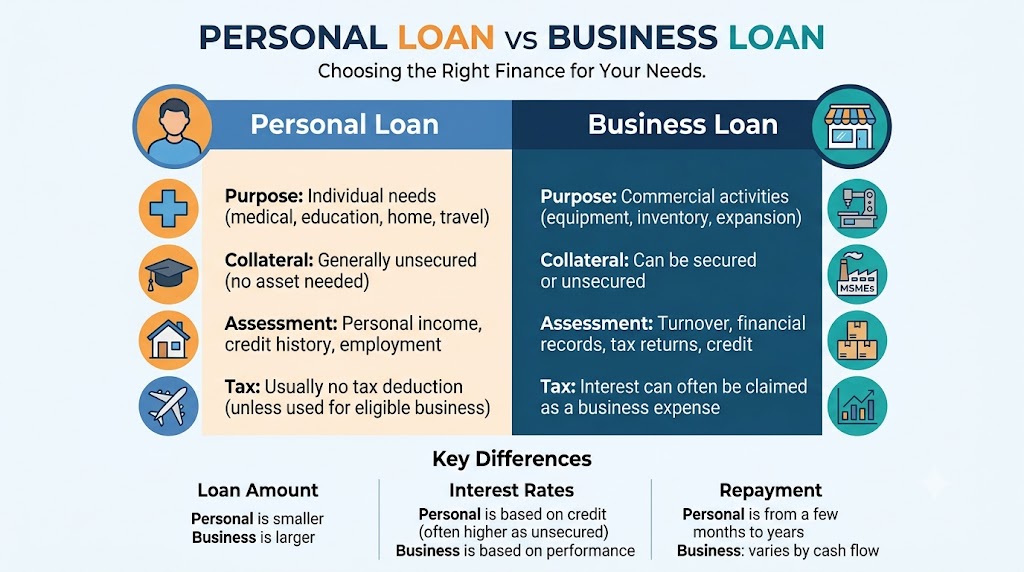
A personal loan is designed to meet an individual's financial needs. It may be used for medical expenses, education, home improvements, travel or debt consolidation, depending on the lender's terms. These loans are generally unsecured, meaning borrowers do not usually need to pledge an asset as collateral.
Lenders typically assess an applicant's income, credit history, employment stability and ability to repay the loan. Since approval is largely based on the individual's financial profile, personal loans can be an option for people who need funds without offering business assets as security.
A business loan, on the other hand, is intended to support commercial activities. Entrepreneurs may use the funds to purchase equipment, replenish inventory, manage working capital, hire employees, open new outlets or expand into new markets. Depending on the lender and loan product, financing may be available on a secured or unsecured basis.
Business loan applications may involve an assessment of turnover, bank statements, financial records, tax returns, business credit history and operating track record. Lenders use this information to understand the business's financial health and repayment capacity.
Key Differences Between the Two Loans
The main difference lies in the purpose of borrowing and how lenders assess repayment ability.
Loan amount: Personal loans are generally suited to individual financial requirements, while business loans may provide larger amounts depending on the enterprise's financial position, borrowing needs and lender eligibility criteria. Actual limits vary significantly between financial institutions.
Interest rates: The rate offered on either loan depends on several factors, including creditworthiness, income or business performance, loan tenure and lender policy. Personal loans may carry relatively high interest rates because they are commonly unsecured. Established businesses with strong financial records may qualify for competitive business loan terms, although this is not guaranteed.
Eligibility and documentation: Personal loans usually focus on personal income, credit history and employment stability. Business loans may require business registration details, financial statements, tax returns and bank records, along with evidence of business performance.
Collateral: Personal loans are generally unsecured. Business loans may also be unsecured, while certain products require collateral, a guarantor or other security. Borrowers should confirm the specific conditions before applying.
Repayment period: Personal loan tenures commonly range from a few months to several years. Business loan repayment periods vary according to the loan type, lender and purpose of finance. Monthly instalments should be planned around the borrower's income or business cash flow.
Approval time: Personal loans can sometimes be approved quickly when an applicant meets the lender's criteria and has the necessary documents. Business loan processing may require a more detailed assessment, although digital applications and streamlined processes can speed up decisions.
When Does a Personal Loan Make Sense?
A personal loan may be suitable when an individual needs funds for a personal expense or a relatively small, immediate requirement. Its flexible usage and typically limited documentation can make it convenient for eligible borrowers.
It may also be considered by an entrepreneur whose business is relatively new and does not yet have the financial history required for certain business loan products. However, using personal borrowing for business purposes means the individual remains responsible for repayment, even if the business experiences losses or cash-flow difficulties.
Before taking a personal loan for a business need, borrowers should compare its total cost with available business financing options. Convenience alone should not determine the decision.
When Should Businesses Consider a Business Loan?
A business loan is generally more appropriate when the funds are intended for commercial activities. It can help a business purchase machinery, increase inventory, manage operating expenses or invest in expansion.
For MSMEs, access to suitable credit can help bridge the gap between expenditure and incoming payments. For example, a retailer may need additional working capital before a busy sales season, while a manufacturer may require equipment to fulfil larger orders.
A dedicated business loan can also help entrepreneurs maintain a clearer distinction between personal and business finances. Building a responsible business credit history may support future borrowing opportunities, subject to the lender's assessment and repayment record.
However, businesses should borrow only after estimating how the funds will be used and how repayments will be met. Expected revenue growth should not be treated as guaranteed income.
Tax Benefits and the Cost of Borrowing
Tax treatment is another factor worth considering. Interest on a personal loan used for ordinary personal expenses generally does not qualify for a tax deduction. In certain circumstances, interest on a personal loan used for an eligible business purpose may be deductible, subject to the applicable tax rules and proper documentation.
Interest on a business loan used for business purposes may generally be claimed as a business expense when the relevant legal and tax conditions are satisfied. The actual treatment depends on the purpose of borrowing, the nature of the expense and the taxpayer's circumstances.
Borrowers should consult a qualified tax professional rather than choosing a loan based solely on a potential tax benefit.
How to Choose the Right Loan
Before applying, borrowers should establish the exact amount required, the purpose of the loan and a realistic repayment plan. Comparing annual interest rates alone is not enough. Processing fees, other charges, prepayment conditions, penalties and the total repayment amount also matter.
Individuals should assess whether their regular income can comfortably cover the monthly instalment. Business owners should examine cash flow, expected revenue, existing debt and the impact of repayments during slower periods.
It is also important to review the loan agreement carefully and avoid borrowing more than necessary. A lower monthly instalment may come with a longer tenure and a higher overall interest cost, so both factors deserve attention.
Conclusion
Personal loans and business loans can both provide useful financial support, but they are designed to address different needs. Personal loans offer flexibility for individual expenses, while business loans are structured to support commercial operations, working capital and expansion.
The right choice depends on the purpose of borrowing, the applicant's financial position, the cost of credit and the ability to repay without creating unnecessary financial pressure.
For individuals, responsible borrowing can help manage important expenses. For entrepreneurs and MSMEs, suitable business finance can support day-to-day operations and long-term growth. In either case, careful comparison and realistic financial planning are essential to making borrowing a useful tool rather than a future burden.