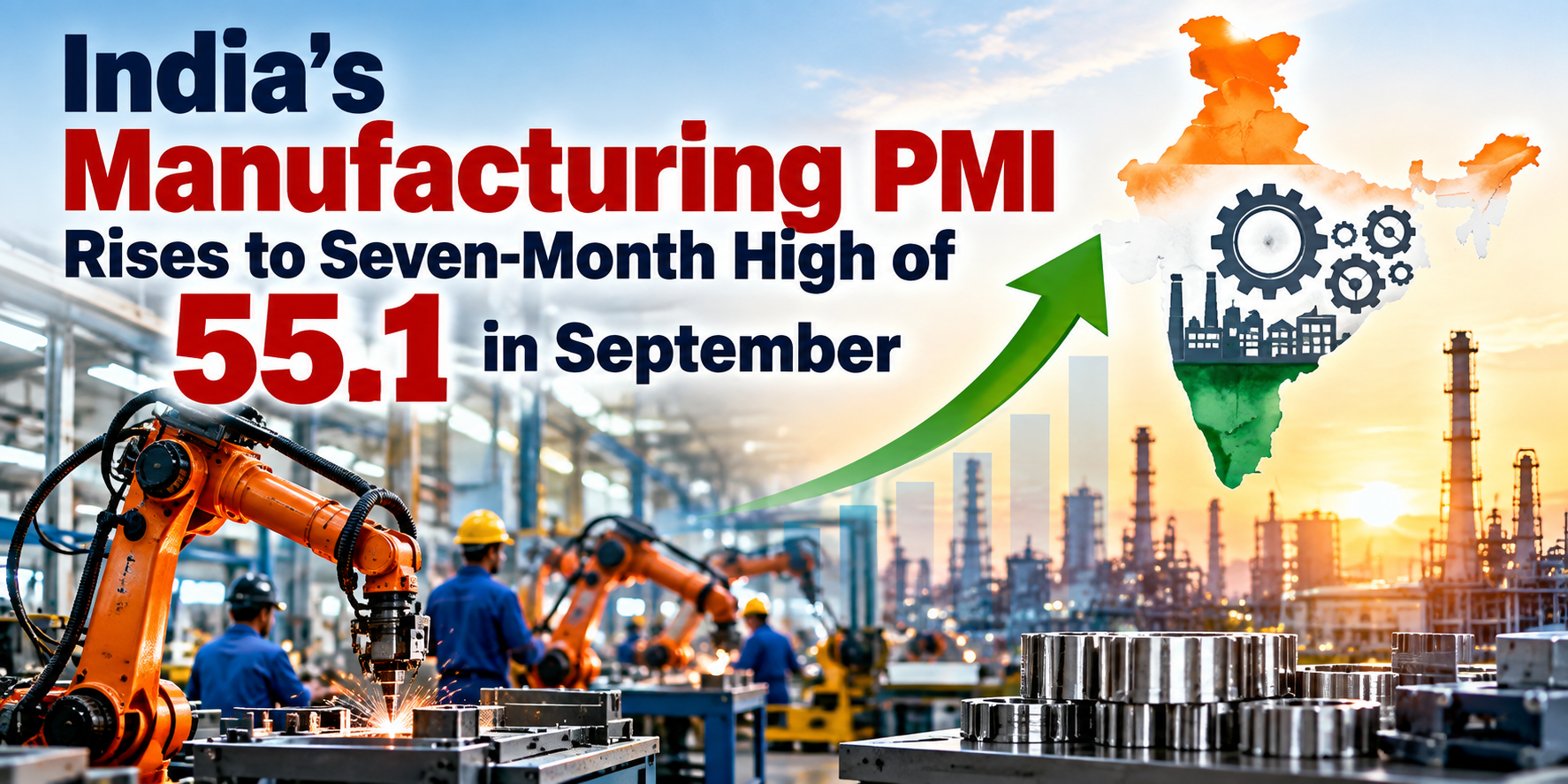
India’s manufacturing sector gained fresh momentum in September, with the Purchasing Managers’ Index (PMI) climbing to 55.1, its highest level in seven months. The improvement signals stronger business activity across the country’s factories, supported by rising customer demand, increased production and improved confidence among manufacturers. The latest reading highlights the resilience of India’s industrial economy amid changing global market conditions.
The September performance marks a recovery from the moderation witnessed in the preceding months, suggesting that manufacturing activity is regaining strength. A PMI reading above 50 indicates expansion, while a figure below that threshold represents contraction. With the index at 55.1, Indian manufacturers continued to operate in expansionary territory, reinforcing the sector’s contribution to economic activity.
A significant driver of the improvement was the acceleration in new orders. Manufacturers reported stronger demand for a range of products, including electronics, pharmaceuticals, food items and textiles. The increase in fresh business provided companies with greater visibility over production requirements and encouraged them to raise operational activity to meet customer commitments.
Factory output also registered a notable improvement, recording its fastest expansion in four months. Manufacturers responded to stronger order books by increasing production volumes, reflecting better utilisation of existing capacities. The rise in output indicates that the improvement in demand is translating into tangible industrial activity rather than remaining limited to new customer enquiries.
Export orders provided additional support to the manufacturing recovery. Indian producers reported stronger international demand, with new business coming from markets including Europe, the United States, Brazil and the United Arab Emirates. The improvement highlights the growing importance of export diversification and India's participation in international supply chains, particularly as businesses seek alternative sourcing and production destinations.
The recovery was visible across manufacturing categories, although performance varied. Intermediate goods emerged as a key contributor, recording stronger growth in orders and production. These products form an important link in industrial supply chains, supporting downstream manufacturing activities. Capital goods, however, experienced comparatively modest growth, indicating that investment-related demand continues to require closer attention.
Employment conditions also improved during September, with manufacturers returning to recruitment after a decline in factory employment in August. Job creation reached its strongest pace since May, reflecting the need for additional workers as production requirements increased. The development is particularly relevant for India, where manufacturing expansion is closely connected with employment generation, skill development and opportunities for the workforce.
Manufacturers simultaneously increased their purchases of raw materials and strengthened inventory levels in preparation for anticipated business requirements. Stocks of purchases expanded at their fastest pace in seven months, while finished-goods inventories recorded a substantial increase. The trend suggests that companies are preparing for stronger sales and seeking to maintain adequate supplies to avoid disruptions in production and delivery schedules.
However, rising inventory levels also bring financial considerations, particularly for smaller businesses. While adequate stocks help manufacturers respond quickly to orders, excessive inventory can lock up working capital and increase storage costs. For MSMEs, balancing procurement, production and cash flow will remain essential to converting stronger demand into sustainable profitability.
Input cost inflation remained an area of concern during September. Manufacturers faced higher expenses for certain raw materials and components, including steel, electronic inputs and pharmaceutical-related materials. Selling prices also increased as companies adjusted to cost pressures. The ability to manage procurement expenses and protect operating margins will therefore remain an important factor influencing manufacturing performance in the coming months.
Business sentiment improved alongside the rise in production and orders, reaching a four-month high. Manufacturers expressed greater confidence in future activity, supported by fresh customer enquiries and expectations of continued demand. Improved sentiment could encourage companies to consider capacity expansion, machinery upgrades, technology investments and workforce development, provided the positive demand environment is sustained.
Despite the September recovery, the broader quarterly picture calls for a balanced assessment. The manufacturing PMI averaged 53.8 during the July–September quarter, representing its lowest quarterly average since the corresponding quarter of 2021. This indicates that the latest improvement follows a period of relatively slower expansion and that sustained growth will depend on continued demand strength rather than a single month's performance.
The manufacturing sector remains central to India's economic transformation, particularly through its contribution to industrial output, exports, employment and the development of domestic supply chains. Greater technology adoption, improved logistics, access to affordable finance and stronger integration of MSMEs into organised manufacturing networks will be important in building a competitive industrial ecosystem. Consistent investment in skills, automation and product quality can further strengthen India's position in global markets.
The rise in India's manufacturing PMI to 55.1 in September provides an encouraging indication of renewed industrial momentum. Stronger orders, rising factory output, recovering employment and improved business confidence offer a supportive foundation for the sector. The next phase will depend on how effectively manufacturers navigate input costs, convert order books into sales and sustain investment. If the momentum continues, manufacturing could play an increasingly important role in supporting India's broader economic expansion and long-term industrial ambitions.