India's steel industry is entering an important phase of growth, supported by rising infrastructure investment, expanding manufacturing activity and increasing demand from construction, automobiles, railways and engineering. From major integrated steel plants to emerging industrial clusters, the sector continues to strengthen India's position in the global steel market.
India is currently the world's second-largest producer of crude steel after China. The country's steel production has increased considerably over the past few years, reflecting growing domestic consumption and investment in manufacturing capacity.
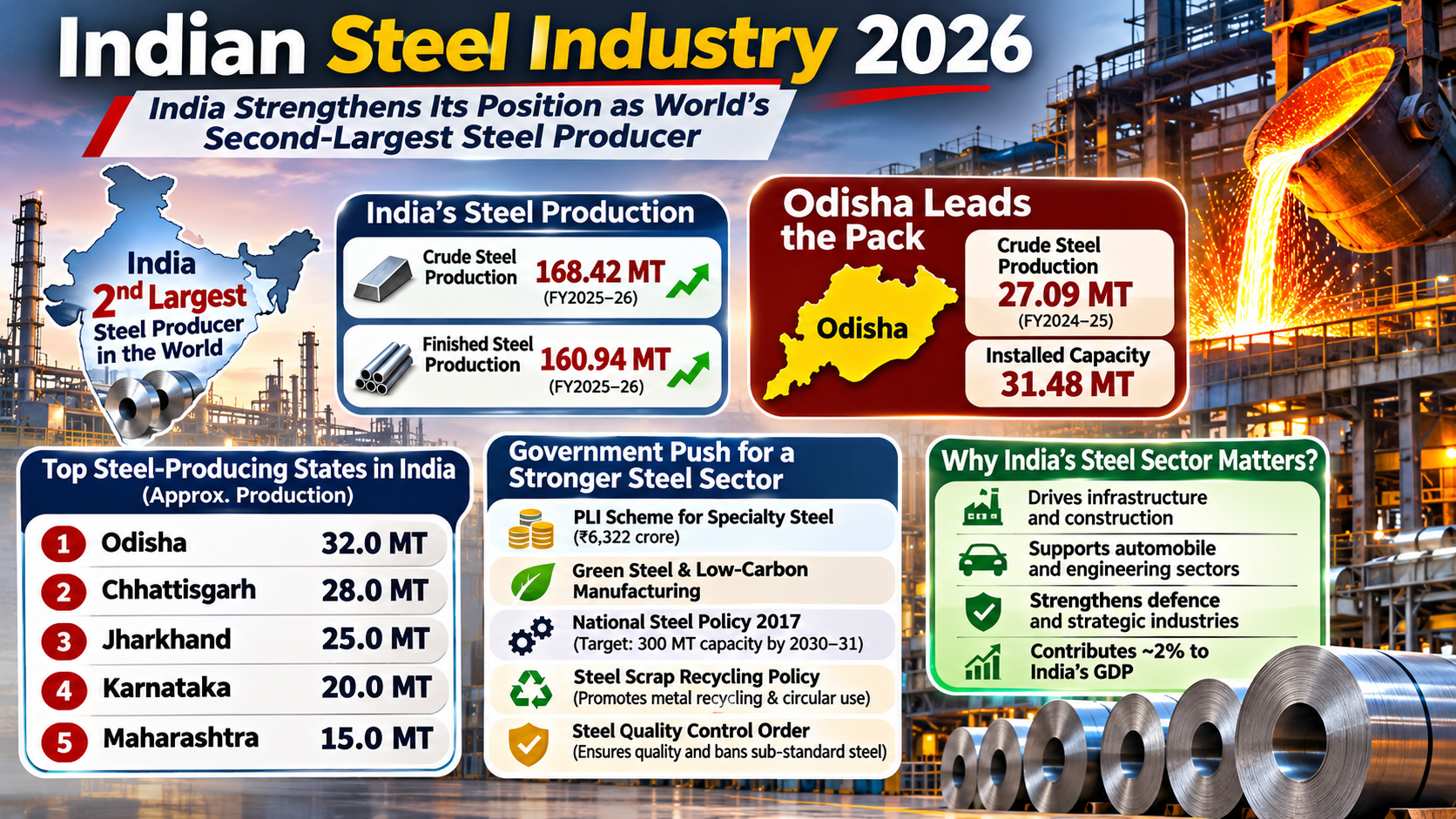
According to the Ministry of Steel, India produced 168.42 million tonnes (MT) of crude steel in FY2025-26, while finished steel production reached approximately 160.94 MT. These figures highlight the industry's expanding role in supporting the country's economic and infrastructure development.
India's Steel Industry Shows Steady Growth in 2026
The latest industry figures indicate that the growth momentum has continued into the current financial year.
During April–September 2026, India's crude steel production reached 85.1 MT, compared with 82.7 MT in the corresponding period last year, registering growth of 2.9%.
Finished steel production stood at 82 MT, up 4.1% from 78.8 MT a year earlier. The demand picture was also encouraging, with finished steel consumption reaching approximately 84.9 MT during the first half of FY2026-27, an increase of 7.5%.
The figures suggest that domestic demand continues to play a major role in supporting steel manufacturers. Infrastructure projects, road construction, railway expansion, housing and industrial development remain important sources of consumption.
Odisha Emerges as a Major Steel Manufacturing Powerhouse
Odisha has established itself as one of India's most important steel-producing states, supported by abundant iron ore reserves, mineral resources and a growing industrial network.
The state recorded crude steel production of 27.09 MT in FY2024-25, with an installed production capacity of 31.48 MT, according to data submitted by the Ministry of Steel to Parliament.
Major industrial centres such as Rourkela, Kalinganagar and Angul have strengthened Odisha's position in the national steel industry.
Some of the major facilities operating in the state include SAIL's Rourkela Steel Plant, Tata Steel's Kalinganagar facility and Jindal Steel's Angul operations.
Beyond manufacturing, the steel industry also supports employment, mining, transportation, logistics and several downstream businesses across Odisha.
Major Steel-Producing States in India
Apart from Odisha, several other states contribute significantly to India's steel manufacturing capacity.
Chhattisgarh is an important steel hub, with Bhilai and Raigarh among its major industrial centres. Jharkhand has a long-established steel manufacturing base, particularly around Jamshedpur and Bokaro.
Karnataka, Maharashtra, Gujarat, West Bengal and Andhra Pradesh also have important steel manufacturing facilities.
These states benefit from different combinations of mineral resources, scrap availability, energy infrastructure, industrial demand and transport connectivity.
Government Initiatives Supporting the Steel Industry
The government has introduced several policies and programmes to strengthen domestic steel production, encourage investment and improve the industry's global competitiveness.
1. Production-Linked Incentive Scheme for Specialty Steel
The PLI scheme for specialty steel carries a financial outlay of ₹6,322 crore. Its objective is to encourage domestic manufacturing of high-value steel products, reduce import dependence and attract investment in advanced production technologies.
The programme has progressed through additional rounds, including PLI 1.1 and PLI 1.2, to widen industry participation.
As of June 2026, participating companies had made actual investments of approximately ₹26,320 crore under the scheme, according to the Ministry of Steel.
2. Green Steel and Cleaner Manufacturing
Reducing carbon emissions is becoming an important priority for India's steel industry.
The government introduced India's Green Steel Taxonomy in December 2024, establishing emission-based standards for identifying and rating green steel.
The framework provides a common basis for measuring the environmental performance of steel production. During FY2025-26, 90 steel units received green steel certification, representing a combined production capacity of approximately 12.4 MT of green steel.
Pilot projects involving green hydrogen in iron and steel manufacturing are also being supported under the National Green Hydrogen Mission.
3. National Steel Policy 2017
The National Steel Policy provides a long-term roadmap for expanding India's steel manufacturing capacity.
It sets a target of 300 MT of crude steel capacity and 255 MT of crude steel production by 2030-31.
Achieving these targets will require continued investment in manufacturing facilities, advanced technology, raw material availability and infrastructure.
4. Steel Scrap Recycling Policy
The Steel Scrap Recycling Policy, introduced in 2019, aims to encourage scientific collection, processing and recycling of steel scrap.
Greater use of recycled steel can improve resource efficiency, reduce dependence on fresh raw materials and support more sustainable manufacturing practices.
5. Quality Standards and Infrastructure Connectivity
The government has also strengthened quality standards through the Steel Quality Control Order, which requires covered steel products to comply with applicable Bureau of Indian Standards specifications.
In addition, the integration of steel manufacturing locations with the PM Gati Shakti National Master Plan is intended to improve planning for railway connectivity, highways, ports and logistics infrastructure.
Challenges Facing India's Steel Industry
Despite strong growth, the industry continues to face several challenges.
Rising energy costs, fluctuations in iron ore and coking coal prices, international competition and environmental regulations can affect manufacturing costs and profitability.
Steel producers are also under increasing pressure to adopt cleaner technologies while maintaining competitive prices.
Improving logistics, ensuring reliable raw material supplies and expanding domestic production of specialty steel will remain important priorities.
What Lies Ahead for the Indian Steel Sector?
India's steel industry has significant opportunities as the country continues to invest in infrastructure, manufacturing and urban development.
The expansion of highways, railways, industrial corridors, housing and renewable energy projects is expected to support long-term steel demand.
For Odisha, the opportunity extends beyond mining and primary steel production. Investment in downstream manufacturing, value-added steel products, logistics and cleaner industrial technologies could create additional economic opportunities.
As India moves towards its 2030-31 steel policy targets, the industry's success will depend on its ability to combine higher production with technological innovation, environmental responsibility and global competitiveness.
The road ahead is not simply about producing more steel. It is about building a stronger, more efficient and sustainable steel industry that can support India's long-term economic ambitions.